My freezer is far from perfect and tends to collect frost like a small glacier.
I tuck items away in it, neatly wrapped, and weeks later everything is rimed in frost, as if a polar breeze has blown through. Over time the ice builds up on the shelves until the interior feels like an arctic exhibit.
Part of caring for this freezer is a regular defrost routine: use up the contents, turn it off, let the temperature rise, remove the thick ice sheets (a strangely satisfying task), clean the interior, and start over.
The most time-consuming step is, of course, using everything up. That can take weeks — I have a squirrel-like tendency to hoard. On my most recent clear-out I found a small tub with two leftover egg whites, remnants from a batch of squeeze cookies that required only the yolks.
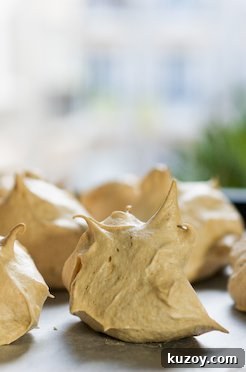
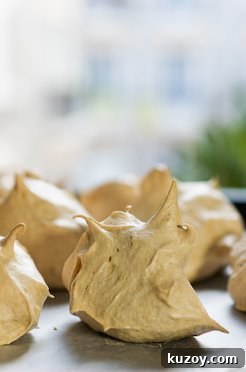
Leftover egg whites usually become coconut macaroons, langues de chat, or delicate tuiles in my kitchen. This time, however, an irresistible urge to make meringues took over. It would be my first time making them properly, and I was excited.
Confession: historically I haven’t been a big meringue fan. As a child, my sister often chose those large, pale pink swirled meringues when we called in at the bakery for an afternoon snack; I could never see the appeal of a large, dry mound of sugar that shed crumbs down your shirt. I preferred chocolate-coated sablés instead.
So why the sudden change? I’d just read an excellent how-to in the copy of Delicious. I brought back from Australia, and the article convinced me that French meringue was well within reach.
Two preferences from my old opinion remain: 1) I want a meringue with a mallowy heart — a little chewy center that’s satisfyingly sticky — and 2) I want real flavor. The first goal is achieved by careful baking and cooling; the second by using a good flavoring or, as I did, an unrefined cane sugar with toffee notes that had been steeped with an empty vanilla pod.
If you’ve never made meringues, or you haven’t in a long time, give this recipe a try: summer is an ideal season for light sweets to top cups of berries or ice cream. I’m already imagining variations with cocoa, floral syrups, ground nuts, or sandwiching them with ganache or fruit preserves.
~~~
* I have long avoided recipes that require whipping egg whites; my stand mixer has been a big help in changing that.
** This recipe produces what is technically called French meringue, as opposed to Italian meringue (made with cooked sugar and not baked) or Swiss meringue (whisked over warm water then cooled).
*** The sugar I used was light brown, which tinted the batter and gave the meringues a pale tan color.
~~~
As a side note, if you read French magazines you might be interested to know the May/June issue of ELLE à table has been refreshed and includes a new column I’ve written.