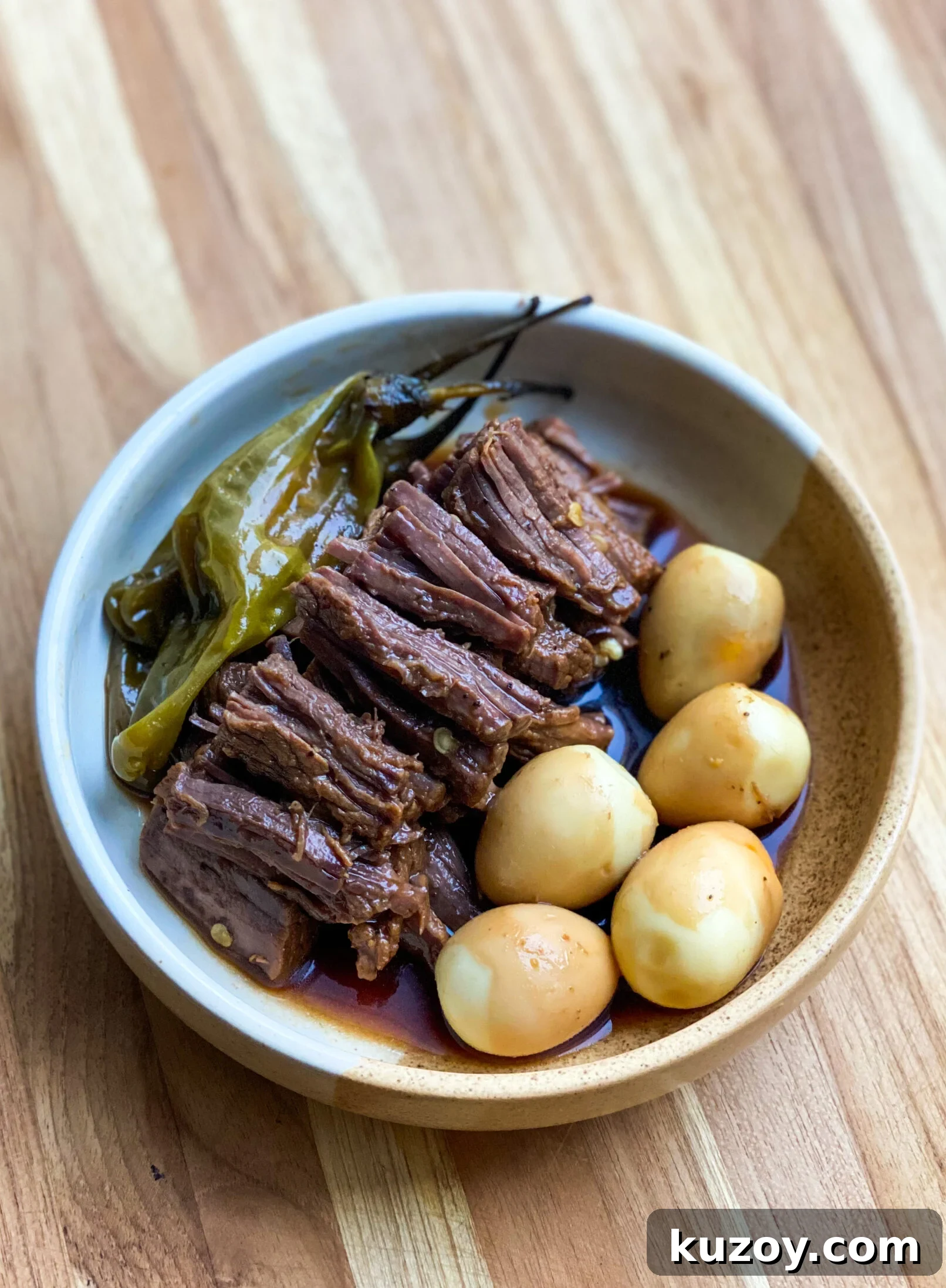
Jang jorim is one of my mother’s favorite banchan. This version follows her method closely, with the main difference being the use of quail eggs instead of chicken eggs for a bite-sized, elegant touch.
This side dish is savory with a gentle sweetness and is meant to be served in small portions. In the past, when beef was expensive and harder to find in Korea, jang jorim offered a frugal way to enjoy beef—rich flavors mean a little goes a long way. A small scoop with a bowl of rice is perfectly satisfying.
Helpful Tips:
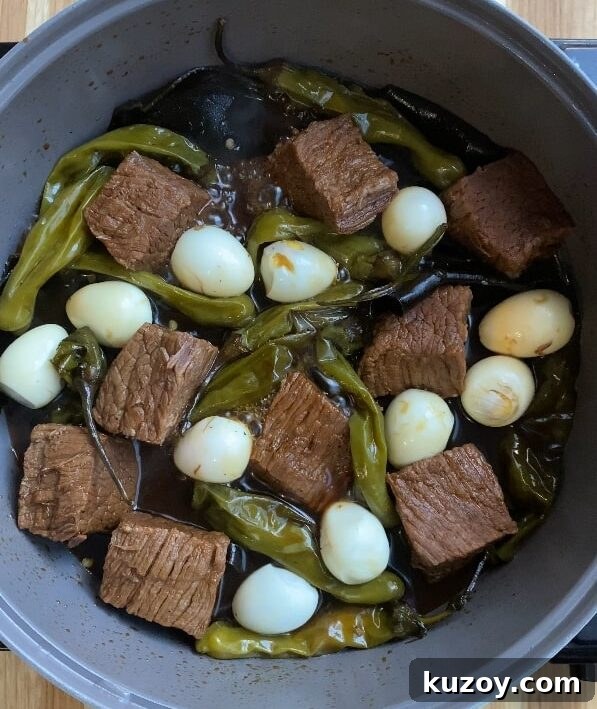
- Use the chili pepper you prefer. Shishito peppers are traditional and mild, but serranos can be used if you want more heat—both work well.
- If you like a bit of crunch, add the peppers only during the last 10 minutes of braising. Shishitos can become too soft if cooked for too long.
5 from 2 votes
Jang jorim 장조림 (Soy Braised Beef)
By Stella Navarro-Kim
A classic Korean soy-braised beef side dish, perfect for banchan.
Prep: 2 hours
Save RecipeSaved Recipe
Pin Recipe
Rate Recipe
Print Recipe
Pin Recipe
Rate Recipe
Print Recipe
Ingredients
- 1 lb brisket or flank steak
- 3 scallions
- 1/2 medium onion
- 2 slices ginger
- 8 garlic cloves
- 1/2 cup Korean radish
- 6 cups water
- 1/2 cup soy sauce
- 2 tbsp mirin
- 2 tbsp sugar
- 1/4 tsp black pepper
- 2 cups beef broth
- 1 oz dried kelp
- 12 quail eggs (or 4 chicken eggs)
- 12 shishito peppers
Instructions
-
Cut the beef into 2–3 inch pieces and soak in cold water for 30 minutes to remove excess blood.
-
In a pot, combine water, scallions, onion, ginger, garlic, and Korean radish. Bring to a boil and simmer for 5 minutes to build a flavorful base.
-
Add the beef, cover, and simmer on medium heat for about 1 hour, until the meat is tender.
-
While the beef cooks, whisk together soy sauce, mirin, sugar, and black pepper to make the seasoning sauce.
-
After an hour, remove the beef and rinse it. Strain the cooking liquid through a fine filter or coffee filter to remove solids and fat so the final sauce stays clear when chilled.
-
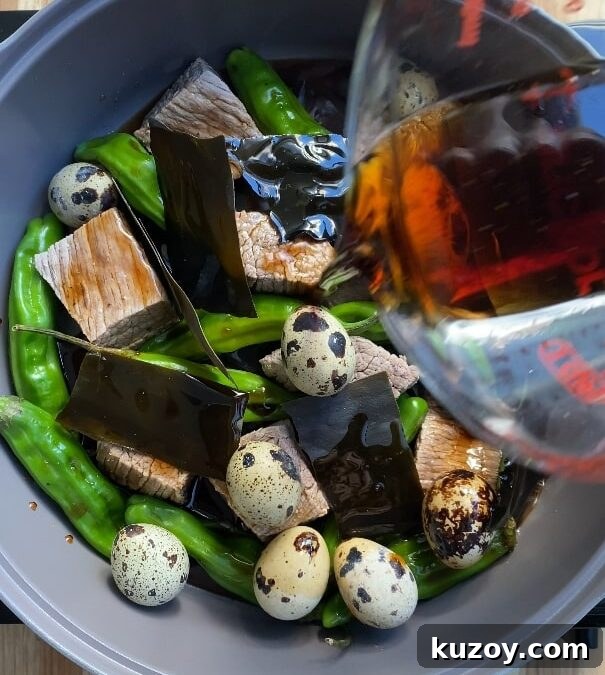
Clean the pot, then return the beef along with the shishito peppers, quail eggs, dried kelp, the seasoning sauce, and 2 cups of the strained beef broth.
-
Cover and simmer on medium heat.
-
After about 5 minutes, remove the quail eggs and peel them while they cool slightly.
-
Return the peeled eggs to the pot and continue braising until the sauce reduces by roughly two-thirds. Total braising time for this step is about 30 minutes, until the sauce is glossy and coats the beef.
-
Let the dish cool, then shred or slice the beef. Serve immediately or store in the refrigerator for up to one week.
Notes
- Jang jorim can be eaten cold straight from the fridge, but heating it briefly will make the beef more tender and the sauce more aromatic.
- Reserve the remaining strained beef broth—it’s flavorful and can be used to make jook (congee) or soups.
- If you enjoy garlic, add a few whole garlic cloves during the braise for extra depth; otherwise omit for a cleaner soy flavor.
Nutrition information is automatically calculated and should be used as an approximation.
Additional Info
Author: Stella Navarro-Kim
Prep Time: 2 hours
Course: Side Dish
Cuisine: Korean
Keyword: Banchan, braised beef, jang jorim, Korean, Korean recipes
Like this recipe? Leave a comment below!